How to set up a Shopify affiliate program in 2026 (step-by-step guide)
Komissio is now on the Shopify App Store. Here is the honest 2026 guide to picking a Shopify affiliate app, comparing 5 main options, and setting up your program step by step.
Contents
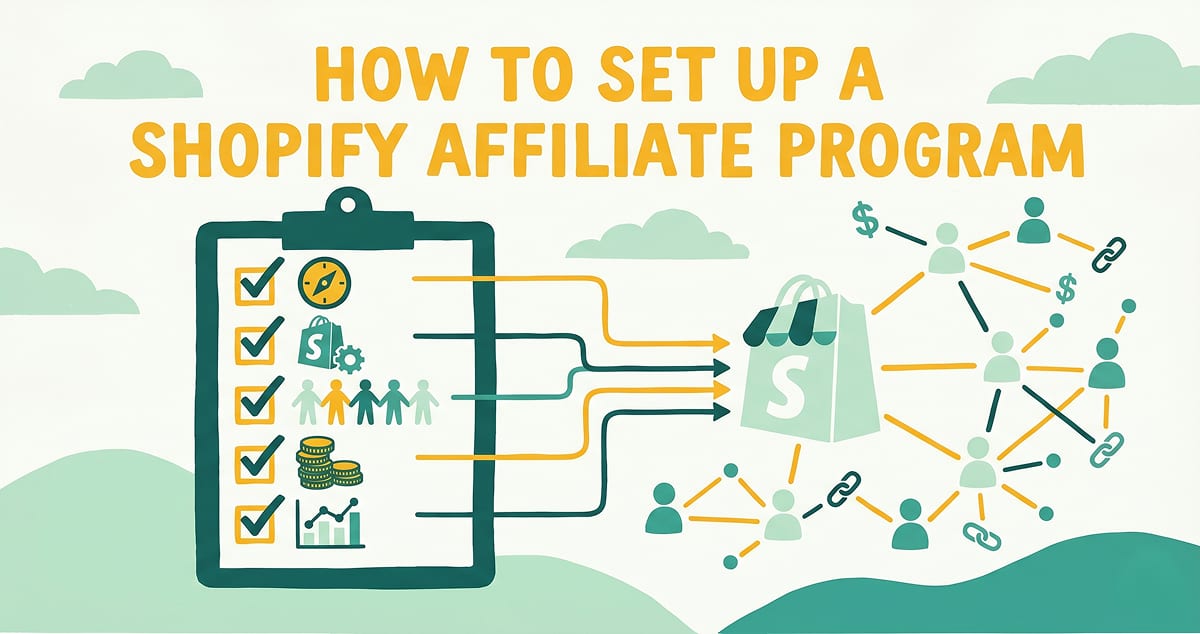
A Shopify affiliate program is a partner-driven sales channel where independent affiliates (creators, bloggers, customers, influencers) earn a commission on every Shopify order they refer using a tracked link. If you run a Shopify store and your affiliate program is currently a spreadsheet, a Google Form, and a monthly bank transfer, this guide is for you.
Setting up a Shopify affiliate program used to mean either paying a percent of your affiliate revenue back to a tool like Refersion, or building tracking yourself with custom theme.liquid edits. Both options have aged badly. Flat-fee Shopify affiliate apps with first-party tracking, installed from the Shopify App Store, turn this into a guided setup instead of a custom development project.
This guide walks you through exactly how to launch a Shopify affiliate program: what to look for in an app, 5 Shopify affiliate apps compared side by side, and the step-by-step setup process using Komissio (which is now live on the Shopify App Store).
Why every Shopify merchant needs an affiliate program in 2026
Three things changed in the last two years that pushed affiliate programs from "nice to have" to essential for Shopify stores:
1. Paid acquisition costs keep rising
Meta and TikTok ad costs have kept climbing in categories like apparel, beauty, supplements, and DTC home goods. Shopify merchants who relied on Facebook ads as their main acquisition channel are watching their CAC quietly eat their margins. An affiliate program shifts you from paying upfront for traffic that might convert to paying a percent only when revenue actually arrives.
2. iOS privacy changes killed remarketing
Apple's App Tracking Transparency and Mail Privacy Protection means a chunk of your retargeting and email-based attribution has gone dark. Affiliate links tracked with a first-party cookie on your own store domain hold up better, because ad blockers and Safari limits drop fewer of those referred sales.
3. AI search is reshaping product discovery
When customers ask ChatGPT, Claude, or Perplexity for product recommendations, the answers cite reviews, comparisons, and blog posts written by affiliates. Stores that pay affiliates to create that content now get cited later. Stores that don't, don't.
Your store's affiliates are not just driving today's traffic. They are building tomorrow's AI search citations.
What to look for in a Shopify affiliate app
Not every Shopify affiliate app is built the same. After seeing what breaks in real merchant programs, here is what actually matters when you choose one:
Flat pricing, not revenue share
Many Shopify affiliate apps charge a base fee plus a percent of affiliate-driven revenue. The percent looks small at signup. It does not stay small. As an illustrative example, on a store doing $100k a month in affiliate sales, a 2% fee on sales is $2,000 every month. For software. Flat-fee apps stay flat no matter how big your program grows.
First-party tracking on your own domain
Where the tracking cookie lives matters. Compare a link that sets a first-party cookie on your own store domain, like
yourstore.com/?ref=anna, with one that sets its cookie on a shared third-party tracking domain such as track.affiliate-tool.example. Ad blockers (uBlock Origin, AdBlock Plus, Brave Shields) and browser protections such as Safari ITP and Firefox ETP target third-party trackers, so referred sales tracked that way can go missing without showing up in your dashboard. A first-party cookie on your store domain (yourstore.com) means ad blockers and Safari limits drop fewer referred sales. Komissio sets it on every plan, and custom tracking domains are available on Enterprise.
Native Shopify integration, not webhook glue
The good Shopify affiliate apps install from the Shopify App Store, read your store orders, credit the referring affiliate, and handle refunds without manual scripts. The bad ones make you paste tracking pixels into your theme.liquid, set up DNS records, and write reconciliation scripts when a customer returns an order.
White-label affiliate portal
Your affiliates should sign up in a portal that carries your brand, not the affiliate tool's. On Komissio, a branded affiliate portal comes with every plan. Full white-label, with your logo, colours and a custom domain, comes with Growth ($99/month). Affiliates with reputations to protect look twice at brands whose affiliate portals look like third-party SaaS dashboards.
Stripe Connect or equivalent for payouts
Manual bank transfers and PayPal mass payouts are how affiliate programs become operational nightmares. Pick an app that handles payouts through Stripe Connect or a comparable rails system. Read our guide on how to pay affiliates with Stripe for why this matters.
Recurring commission support for subscriptions
If your store sells subscriptions (Recharge, Bold Subscriptions, or Shopify's native subscriptions), your affiliate app needs to track recurring commissions month after month, not just on first purchase. Otherwise affiliates have no reason to drive subscription signups versus one-time orders.
The 5 best Shopify affiliate apps in 2026
These are the five apps that meet most of the criteria above. Compared honestly, including where each one falls short.
1. Komissio
Komissio launched on the Shopify App Store in 2026 and is built around three principles: a flat plan price that never takes a share of your sales (Starter $49 a month, Growth $99 a month), first-party cookie tracking on your store domain on every plan, and automatic affiliate payouts through Stripe Connect.
Pricing: Starter $49 per month for up to 50 active affiliates. Growth $99 per month with unlimited affiliates. No revenue caps. No share of sales. 14-day free trial on every plan.
Best for: Shopify stores that want a price that stays flat as affiliate sales grow, automatic Stripe Connect payouts, and first-party tracking. Stores that want full white-label with a custom domain can move to Growth.
What is missing: Newer to the Shopify ecosystem than Refersion or GoAffPro, so the review count is still building. No free plan beyond the 14-day trial. Tiered and recurring commissions and white-label need Growth.
Install Komissio on the Shopify App Store →
2. Refersion
Refersion is a long-running Shopify affiliate app, popular with established DTC brands. It has a free marketplace tier, and its paid plans charge a monthly fee plus a share (3% or 2%) of affiliate-generated sales, so the cost grows with your program.
Pricing: Free marketplace tier. Paid plans charge a monthly fee plus a percentage of affiliate-generated sales. Check their current listing for plan prices.
Best for: Established brands that want a long-running tool and accept a fee on affiliate sales. If you are already on Refersion and happy, there is nothing wrong with it.
What is missing: Paid plans take a percentage of affiliate sales, which adds up as volume grows. It does list one-click payouts and a first-party tracking domain on paid plans. Check which features each plan includes.
3. GoAffPro
GoAffPro has a free plan and flat monthly paid plans with no fee on sales, plus automatic payouts. It is a common starting point for stores that want to test an affiliate program before paying more for software.
Pricing: Free plan and flat monthly paid plans, with no fee on sales. Higher tiers are recommended for stores with more daily orders. Check their current listing for prices.
Best for: Smaller Shopify stores just starting out who want to test an affiliate program before paying for software.
What is missing: The recommended tier rises with daily order volume. Its listing does not state first-party tracking, so check the listing if tracking method matters to you.
4. UpPromote
UpPromote is a widely used Shopify affiliate app with a free plan and a broad feature set.
Pricing: Free plan. Paid plans add a performance fee of 1% to 2% of referral sales. Check their current listing for monthly plan prices.
Best for: Stores that want a free plan and accept a percentage fee on paid plans.
What is missing: Paid plans take a percentage of referral sales, and automatic PayPal payouts start on the Professional plan, so they are not on every plan.
5. Shopify Collabs
Shopify Collabs is Shopify's own app for working with creators and affiliates. It is free to install and pays commissions automatically.
Pricing: Free to install. A payout fee of up to 2.9% may apply to automatic commission payments.
Best for: Brands that mainly work with creators and want a tool built by Shopify.
What is missing: The fee on automatic payments grows with the commissions you pay. It is focused on creators, so check that it fits a classic affiliate program. The tracking method is not stated on its listing.
Shopify affiliate apps: side-by-side comparison
Competitor details checked against each app's Shopify App Store listing and pricing page on September 14, 2026. "Check listing" means we could not confirm it there; it does not mean no. Prices and plans change, so check each app's current listing.
| Feature | Komissio | Refersion | GoAffPro | UpPromote | Shopify Collabs |
|---|---|---|---|---|---|
| Pricing model | $49/mo flat (Starter) | Free tier; paid plans add % of sales | Free plan; flat paid plans | Free plan; paid plans add % of sales | Free to install; fee on payouts |
| Fee on sales | 0% | 3% or 2% on paid plans | None | 1% to 2% on paid plans | Payout fee up to 2.9% |
| First-party tracking | Yes, every plan | Paid plans | Check listing | Check listing | Check listing |
| White-label portal | Branded portal; white-label on Growth | Check listing | Check listing | Check listing | Check listing |
| Automatic payouts | Stripe Connect | Yes, one-click | Yes | PayPal, Professional and above | Yes |
| Recurring commissions | Growth plan | Check listing | Check listing | Check listing | Check listing |
If you want a deeper dive into how Komissio stacks up against the affiliate platforms used outside Shopify too, read our Komissio vs Rewardful vs FirstPromoter comparison.
How to set up your Shopify affiliate program (with Komissio)
Go to apps.shopify.com/komissio and click Add app. Approve the Shopify permissions the app requests. The app installs to your store.
In the Komissio dashboard, click Connect Stripe. You will be redirected to Stripe's Connect onboarding, which Komissio uses to handle affiliate payouts. If you already use Shopify Payments, this is the parallel rail for paying affiliates. Stripe handles KYC, multi-currency, and the audit trail.
Set your commission rate. For most Shopify stores, 10% to 20% on first purchase is a common range. Flat and percentage rules are on every plan, and tiered or recurring commissions are on Growth. Set your cookie duration (30 to 60 days is standard). On Growth, set up clawbacks so a commission is reversed when a referred order is refunded or charged back.
Every plan includes a branded affiliate portal where affiliates sign up and find their links, campaigns and promo materials. On Growth, white-label adds your logo, colours and a custom domain such as partners.yourbrand.com, so affiliates sign up on your own domain. The portal is then ready for affiliates.
Personal outreach to people who already know your brand usually works better than a public signup link. Email 5 happy customers, partners, or content creators in your niche with a personal note and the signup link. Read our guide on how to start an affiliate program for ecommerce for the exact outreach templates. That is the whole setup. How long it takes depends mostly on having your commission structure, branding and first affiliates decided before you install.
This walkthrough uses Komissio because we built it and know each step in detail. The general flow works the same on most apps; only the screens differ.
Step 1: Install from the Shopify App Store
Go to apps.shopify.com/komissio and click Add app. Approve the Shopify permissions the app requests. The app installs to your store.
Step 2: Connect Stripe for payouts
In the Komissio dashboard, click Connect Stripe. You will be redirected to Stripe's Connect onboarding, which Komissio uses to handle affiliate payouts. If you already use Shopify Payments, this is the parallel rail for paying affiliates. Stripe handles KYC, multi-currency, and the audit trail.
Step 3: Configure your commission structure
Set your commission rate. For most Shopify stores, 10% to 20% on first purchase is a common range. Flat and percentage rules are on every plan, and tiered or recurring commissions are on Growth. Set your cookie duration (30 to 60 days is standard).
On Growth, set up clawbacks so a commission is reversed when a referred order is refunded or charged back.
Step 4: Set up your branded affiliate portal
Every plan includes a branded affiliate portal where affiliates sign up and find their links, campaigns and promo materials. On Growth, white-label adds your logo, colours and a custom domain such as
partners.yourbrand.com, so affiliates sign up on your own domain. The portal is then ready for affiliates.
Step 5: Invite your first 5 affiliates
Personal outreach to people who already know your brand usually works better than a public signup link. Email 5 happy customers, partners, or content creators in your niche with a personal note and the signup link. Read our guide on how to start an affiliate program for ecommerce for the exact outreach templates.
That is the whole setup. How long it takes depends mostly on having your commission structure, branding and first affiliates decided before you install.
Common mistakes Shopify merchants make with affiliate programs
Setting commission rates by feel, not by math
Most stores pick 10% or 20% commission because it "feels right". Real math: if your gross margin is 60%, paying 25% commission still leaves 35% for the business. If your gross margin is 30% (common in apparel), paying 25% commission leaves you with 5%, which is barely a business. Calculate before you pick.
Launching without a creative kit
Affiliates need something to share. At minimum: 3 to 5 product images, a one-line product description, and a tracking link. If they have to make their own creative from scratch, most never do. Spend an hour preparing a basic kit before you invite affiliates.
Auto-approving every signup
Public affiliate signup pages attract three types of applicants: real affiliates with audiences, employees of your competitors (who use it for competitive intel), and bots. Manual approval in the first month is worth the few moments per applicant it costs.
Treating affiliates like a one-time send
Affiliates need ongoing engagement. A monthly email with new products, promo codes for big shopping days, and a leaderboard of top earners keeps far more affiliates active than silence after signup.
Forgetting first-party tracking matters
If you pick a Shopify affiliate app that sets its tracking cookie on a shared third-party domain, ad blockers and Safari limits will drop some referred sales without the loss ever showing in your dashboard. Read our guide to first-party affiliate tracking for why this is the single highest-leverage configuration decision you can make.
Key takeaways
Key Takeaways
A Shopify affiliate program is one of the few channels in 2026 where you pay only when revenue arrives, not upfront for traffic that might convert.
Pick a Shopify affiliate app with flat pricing, first-party tracking on your own domain, native Shopify order and refund handling, and a branded affiliate portal.
Komissio bundles a flat plan price with no share of sales ($49/month Starter, $99/month Growth), first-party tracking on every plan, and automatic Stripe Connect payouts. White-label with a custom domain comes with Growth.
Refersion and UpPromote paid plans take a percentage of affiliate sales, and Shopify Collabs has a payout fee of up to 2.9%. GoAffPro keeps flat plans with no fee on sales.
Setup goes faster when you decide your branding and commission structure before installing.
Manual approval of affiliate signups in the first month catches competitor employees and bots before they distort your analytics.
First-party tracking is the single highest-leverage configuration choice, because ad blockers and Safari limits drop fewer referred sales when the cookie sits on your own domain.
Frequently asked questions
What is the best Shopify affiliate app for a small store?
For a very small store, a free plan usually costs least at first: GoAffPro, UpPromote and Refersion list free plans, and Shopify Collabs is free to install. As affiliate sales grow, fees matter more, because UpPromote and Refersion paid plans take a percentage of affiliate sales. GoAffPro and Komissio use flat plan prices. Komissio Starter is $49 a month for up to 50 active affiliates, with a 14-day free trial and no share of sales.
How much does it cost to run a Shopify affiliate program?
Software cost depends on the pricing model. Komissio is a flat $49 a month on Starter or $99 on Growth, with no share of sales. UpPromote and Refersion paid plans add a percentage of affiliate sales, and Shopify Collabs has a payout fee of up to 2.9%. Check their current listing for plan prices. On top of software, you pay your affiliates a commission on the sales they drive, typically 10% to 25% for ecommerce. Illustrative example: a store doing $10,000 a month in affiliate sales at 20% commission pays $2,000 in commissions plus the software fee, about $2,049 a month on Komissio Starter. Run your own numbers at komissio.io/calculator.
Does Komissio work with Shopify Markets and multi-currency?
Komissio supports USD, EUR, GBP, TRY and AZN. Commissions and payouts are recorded in your program's currency and paid out through Stripe Connect. If you sell in several currencies through Shopify Markets, book a walkthrough at cal.com/komissio to check how your setup maps before you launch.
Can I run an affiliate program on a Shopify store without an app?
Technically yes. You can build attribution into your theme.liquid with custom JavaScript, use Shopify's discount code system for tracking, and reconcile commissions in a spreadsheet. Practically, it tends to break as the program grows. Refund reconciliation, recurring commissions, multi-currency, and affiliate self-service portals are hard to maintain manually, which is why many stores that go this route move to a dedicated Shopify affiliate app.
How do I prevent affiliate fraud on Shopify?
The two biggest fraud vectors on Shopify affiliate programs are coupon-code self-purchase (someone signs up as an affiliate, then buys their own order with their own discount code) and click fraud (bots inflating click counts). Komissio covers both: duplicate click detection and self-referral blocking on every plan, plus velocity and geo-mismatch checks on Growth. Flagged conversions are held for review before you pay. Manual review of any single commission above $100 in the first 60 days is also a healthy hygiene practice.
How long until a Shopify affiliate program starts making money?
Most Shopify affiliate programs see their first attributed sale within 2 weeks of inviting affiliates, but meaningful revenue (10+ orders per month) usually takes 60 to 90 days. The pattern: weeks 1 to 4 you sign up affiliates, weeks 4 to 8 they create content or run promotions, weeks 8+ that content starts ranking and converting. Programs that are still flat by month 4 usually have a recruitment problem (not enough quality affiliates), not a software problem.
What is the best commission rate for a Shopify affiliate program?
For most ecommerce categories, 10% to 20% on first purchase is the standard range. Apparel and beauty typically pay 10% to 15%. Supplements and high-margin DTC often pay 20% to 30%. Subscription products often use a tiered structure: 20% on first order plus 5% to 10% recurring. Use your gross margin as the ceiling, and never pay more in commission than half your gross margin, or unit economics break.
Ready to launch your Shopify affiliate program?
Komissio is now live on the Shopify App Store. Install it from the App Store, connect Stripe, and start with a 14-day free trial on any plan.
Install Komissio on Shopify → · Try the interactive demo first · Or book a 15-minute walkthrough
Related reading
How to start an affiliate program for your e-commerce store: the underlying playbook this Shopify guide is built on.
First-party affiliate tracking: why your program is losing conversions: why first-party tracking matters more than most merchants realize.
How to pay affiliates with Stripe (without losing your mind): the operational side of running payouts.
Best Rewardful alternative for SaaS founders in 2026: if you also run a SaaS, the same flat-fee logic applies.