How to start an affiliate program for your e-commerce store (step-by-step guide)
A practical 7-step guide to launching a profitable affiliate program for your online store. Covers commission structures, tracking platforms, affiliate recruitment, and optimization.
Contents
Learning how to start an affiliate program is one of the highest-leverage moves an e-commerce founder can make. Affiliate marketing drives a disproportionate share of online revenue for a channel most stores set up as an afterthought — yet it accounts for 16% of all e-commerce sales in the US.
That number has grown every year for a decade, and the reason is simple: affiliates only get paid when they produce results. No impressions to buy. No CPM guesswork. You pay a commission when a sale actually happens.
This guide walks you through launching an affiliate program from scratch — from setting your commission structure to recruiting your first 10 partners. Every step includes specific numbers, templates, and decision frameworks so you can move from "I should probably do this" to "my affiliates generated their first sales" in under two weeks.
What is an affiliate program (and why learn how to start an affiliate program now)?
An affiliate program is a performance marketing arrangement where you pay independent promoters — called affiliates — a commission for each sale they send to your store. Affiliates share unique tracking links on their websites, email lists, social media accounts, or paid ad campaigns, and when a customer clicks that link and makes a purchase, the affiliate earns a percentage or flat fee from the sale.
The economics make it one of the lowest-risk acquisition channels available. Unlike paid ads where you spend money before knowing whether it will convert, affiliate commissions are a post-sale expense. Your cost of acquisition is fixed and predictable. If an affiliate sends you a customer who spends $120 and your commission rate is 15%, you pay $18. If they send zero customers, you pay zero.
For context, the average e-commerce store spends 10-20% of revenue on customer acquisition through paid channels with no guarantee of return. An affiliate program lets you cap that cost at the exact rate you choose and only pay it on confirmed revenue.
But affiliate programs are not the same as referral programs or influencer campaigns. Here is how they differ:
| Affiliate program | Referral program | Influencer program | |
|---|---|---|---|
| Who promotes | Content creators, bloggers, comparison sites, coupon sites, niche publishers | Existing customers | Social media personalities |
| Motivation | Commission per sale | Discount or store credit | Flat fee, free product, or commission |
| Scale potential | Hundreds to thousands of partners | Limited to customer base | Typically 10-50 relationships |
| Tracking method | Unique affiliate links with cookies | Referral codes | UTM links or promo codes |
| Payment trigger | Confirmed sale (performance) | Friend's first purchase | Content delivery or sales |
| Typical cost | 5-30% of sale value | $10-25 credit per referral | $200-10,000+ per post |
A referral program turns your existing customers into advocates. An influencer program buys reach from individuals with audiences. An affiliate program builds a distributed sales force of people who are motivated by ongoing commission income. Most mature e-commerce brands run all three, but an affiliate program is the one that scales independently once it is running.
Before you start an affiliate program, make sure your store meets the minimum requirements below. Launching too early is the most common reason affiliate programs fail in their first 90 days.
Before diving into how to start an affiliate program, make sure your store meets the minimum requirements below. Launching too early is the most common reason affiliate programs fail in their first 90 days.
Is your store ready for an affiliate program?
Not every store should launch an affiliate program today. Launching too early wastes time and can create bad first impressions with affiliates you will want to work with later.
Minimum requirements before you launch
You need four things in place before inviting affiliates:
Proven product-market fit. Your store should be generating consistent organic or paid sales. If customers are not buying from you directly, affiliates will not fix that problem — they amplify demand, they do not create it.
Functional checkout and fulfillment. Your conversion rate should be at least 1.5-2%. Affiliates will not keep sending traffic to a store that does not convert or ships late.
Margins that support commissions. If your gross margin is 40%, offering a 20% affiliate commission leaves you 20% before operating costs. Run the numbers before you commit to a rate.
A product page that sells. Affiliates drive traffic; your site closes the sale. Product descriptions, images, reviews, and trust signals need to be solid.
Common reasons stores launch too early
The three mistakes I see most often:
"We'll use affiliates instead of paid ads." Affiliates are a complement, not a replacement. If you have not validated your offer through any channel, you are asking affiliates to do your market research for free.
"We just need more traffic." If your site converts at 0.5%, doubling traffic through affiliates just doubles your bounce rate. Fix the funnel first.
"We launched last week." Serious affiliates check your store before promoting it. No reviews, no social proof, and a domain registered five days ago will get your application ignored.
If you meet the minimum requirements above, move on to Step 1.
Step 1 — How to start an affiliate program: define your commission structure
Your commission structure is the single biggest factor in whether affiliates choose to promote your products or your competitor's. Set it too low and nobody signs up. Set it too high and you erode your margins. The goal is to find the rate that makes promoting you more attractive than the alternatives while keeping your unit economics healthy.
Flat rate vs percentage vs tiered commissions
There are three standard commission models. Most programs use percentage-based commissions, but the right choice depends on your product catalog.
| Model | How it works | Best for | Example |
|---|---|---|---|
| Flat rate | Fixed dollar amount per sale | Single product or narrow price range | $15 per sale on a $99 product |
| Percentage | % of order value | Varied product catalog, different price points | 12% of order value |
| Tiered | Rate increases at volume thresholds | Rewarding top performers, encouraging growth | 10% for 1-20 sales/mo, 15% for 21-50, 20% for 51+ |
Industry benchmarks vary by category, but here are typical affiliate commission rates for e-commerce:
Fashion and apparel: 8-15%
Beauty and skincare: 10-20%
Health and supplements: 15-30%
Electronics and gadgets: 3-8%
Home and garden: 8-12%
Digital products and SaaS: 20-40%
Start at the median for your category. You can always increase rates for top performers, but cutting rates after launch damages trust.
Setting your cookie duration
Cookie duration determines how long after an affiliate's click a sale can still be attributed to them. The industry standard is 30 days, meaning if someone clicks an affiliate link on March 1 and buys on March 28, the affiliate earns the commission.
Shorter cookies (7-14 days) make sense for impulse purchases. Longer cookies (60-90 days) make sense for high-consideration products where buyers research for weeks before committing. Most e-commerce programs settle on 30 days as a reasonable default.
One technical note: traditional third-party tracking cookies are increasingly blocked by browsers and ad blockers. First-party attribution — where the tracking cookie is set on your own domain rather than a third-party tracking domain — survives these blocks far more reliably. When evaluating tracking platforms, ask whether they support first-party cookie attribution. The difference in tracked conversion accuracy can be 15-25%.
Clawback and refund policies
Decide upfront what happens to commissions when a customer returns a product or requests a chargeback. The standard approach is a clawback policy: if a customer returns an order within your return window, the affiliate's commission is reversed.
Be explicit about this in your affiliate terms. Most affiliates expect clawbacks on genuine returns — what frustrates them is ambiguity. State the clawback window (typically matching your return policy, 30-60 days), and make sure your tracking platform logs every clawback with a reason so affiliates can see exactly what happened.
Use this calculator to model your commission economics:
Affiliate commission calculator
Step 2 — Choose the right affiliate program software
You need software to generate unique affiliate links, track clicks and conversions, calculate commissions, and process payouts. Doing this manually with spreadsheets works for about two weeks before the first attribution dispute makes you regret it.
What to look for in affiliate software
Not all tracking platforms are built the same. Here is what matters most when you are evaluating options:
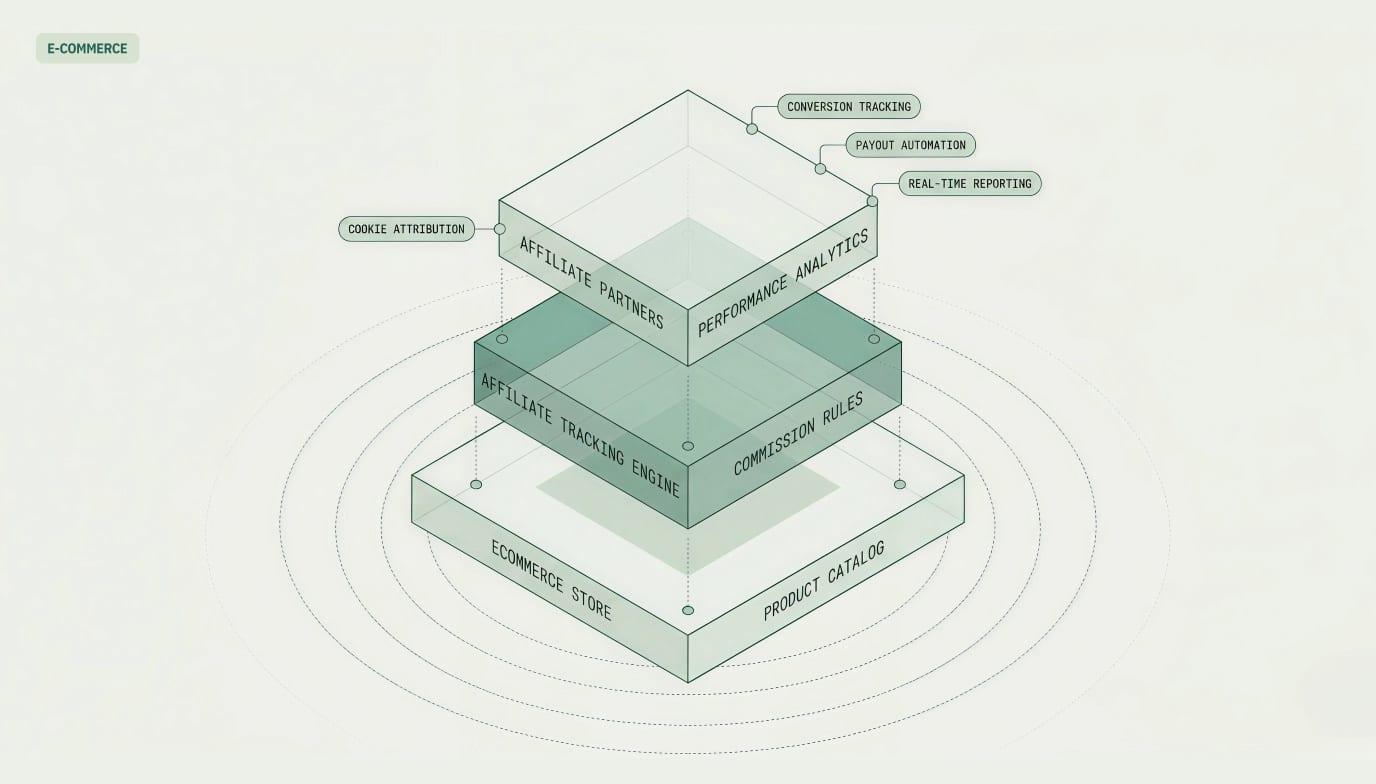
First-party tracking. Cookie-based attribution set on your domain, not a third-party domain. This is non-negotiable in 2026 with browser privacy changes.
Real-time reporting. Affiliates should see their clicks and conversions as they happen, not in a batch report 24 hours later. Delayed reporting kills affiliate motivation.
Automated payouts. Manual bank transfers do not scale past 10 affiliates. Look for direct bank payout integrations (Stripe Connect or equivalent) with a full audit trail.
Flexible commission rules. You should be able to set flat, percentage, and tiered rates, and ideally assign different rates to different affiliates or campaigns.
Promotional material hosting. Affiliates need banners, email swipes, and deep links in one place. If they have to email you asking for creative assets, you have already lost their attention.
Link reliability. Affiliate links should survive ad blockers and not look like obvious tracking URLs. Link stealth and custom tracking domains improve both click-through rates and tracking accuracy.
Komissio covers all of the above — real-time tracking, Stripe Connect payouts, first-party attribution cookies, custom tracking domains, and a promotional materials library — but regardless of which platform you choose, make sure these six capabilities are present. Start a free demo to test the full workflow without entering a credit card.
Build vs buy vs marketplace
You have three options:
Build it yourself. Only makes sense if you have an engineering team with nothing else to do. Affiliate tracking has edge cases — cookie expiration, cross-device attribution, fraud detection, tax reporting — that will consume months of development time. Not recommended unless you are processing 100,000+ affiliate sales per month and need something deeply custom.
Buy standalone software. This is the right choice for most stores. Monthly costs range from $0 (free tiers with limited affiliates) to $500+/month for enterprise platforms. You get tracking, reporting, payouts, and affiliate management in one interface.
Join an affiliate marketplace. Networks like ShareASale or CJ Affiliate give you access to their existing affiliate base, but they take a significant cut (often 20-30% on top of your commission) and you do not own the affiliate relationships. Good for exposure, but expensive and limiting long-term.
For most e-commerce stores doing $50K-$5M in annual revenue, standalone software is the best balance of cost, control, and capability.
A critical part of learning how to start an affiliate program is getting the legal and operational terms right from day one.
Step 3 — Create your affiliate program terms
Your affiliate agreement is a legal document, but it is also a sales document. It tells potential affiliates exactly what they are signing up for and what you expect from them.
What your affiliate agreement should include
At minimum, cover these points:
Commission rates and structure (flat, percentage, tiered)
Cookie duration (how long after a click a sale is attributed)
Payment schedule and minimum payout threshold (e.g., monthly payouts, $50 minimum)
Clawback and refund policy (when commissions are reversed)
Prohibited promotion methods (typically: spam, trademark bidding on branded PPC terms, coupon sites without approval, misleading claims)
Brand usage guidelines (how affiliates can and cannot use your logo, product images, and brand name)
Termination clause (either party can end the relationship with 30 days notice)
Compliance requirements (FTC disclosure obligations for affiliate relationships)
Do not write this from scratch. Start with a template from your legal counsel or tracking platform, then customize it for your business.
Setting payment terms and schedules
The standard in e-commerce affiliate programs is monthly payouts with a 30-day hold period. This means commissions earned in January are paid out in early March, giving you time to account for returns and chargebacks.
Set a minimum payout threshold of $25-50. Thresholds below $25 create administrative overhead. Thresholds above $100 discourage new affiliates who want to see their first payout quickly.
The faster and more transparent your payouts, the more attractive your program. Affiliates talk to each other. Programs with slow or opaque payment processes develop reputations quickly — and those reputations are hard to reverse.
Step 4 — Build your affiliate signup page
Your affiliate signup page is where potential partners decide whether your program is worth their time. Treat it like a landing page for a product, because it is — the product is your affiliate program.
What high-converting signup pages include
The best affiliate signup pages have five elements:
Commission rate front and center. Do not make affiliates hunt for this. "Earn 15% on every sale" should be above the fold.
Cookie duration and payment terms. Affiliates compare programs. Make the comparison easy.
Product information. What are they promoting? Average order value, conversion rate (if you are willing to share it), and target audience.
Social proof. Customer reviews, press mentions, or sales volume. Affiliates want to promote products that sell.
Simple application form. Name, email, website/social channels, and a brief description of how they plan to promote. Do not ask for 15 fields. Every extra field reduces completions.
Approval workflow: auto-approve vs manual review
Auto-approve gets affiliates promoting faster but lets in low-quality partners, coupon scrapers, and potential fraudsters. Manual review gives you control but creates a delay that loses some applicants.
The best approach for most stores: auto-approve with a probation period. Let affiliates start immediately, but flag any affiliate who has not generated a click within 14 days for review. This balances speed with quality control.
If you are in a regulated industry (finance, health, alcohol), always use manual review. The compliance risk of an unapproved affiliate making prohibited claims about your products is not worth the speed gain.
Many guides on how to start an affiliate program skip this step — but it is the difference between affiliates who promote and affiliates who never send a single click.
Step 5 — Prepare your promotional materials
Affiliates are not your marketing team. They should not have to create banners, write email copy, or figure out which product pages to link to. If you make promotion easy, more affiliates will actually promote you. If you do not, most will sign up and never send a single click.
The minimum creative kit for launch
Prepare these assets before you invite your first affiliate:
3-5 banner ads in standard sizes (728x90, 300x250, 160x600, 1200x628 for social)
2 email swipe templates (one introduction, one promotional) that affiliates can customize
Deep links to your top 5-10 products or category pages, not just your homepage
A one-paragraph product description affiliates can copy and paste
Your logo in PNG and SVG formats
A seasonal promotions calendar so affiliates know about upcoming sales in advance
Host all of these inside your affiliate tracking platform so partners can grab what they need without emailing you.
Why most programs fail at this step
The number one reason affiliates sign up for a program and never promote: they do not know what to do next. They land on an empty dashboard with no banners, no suggested products, and no guidance.
The first 48 hours after an affiliate joins are critical. If they find ready-to-use materials and can generate their tracking link in under two minutes, your activation rate jumps. If they have to email you asking for a logo, they are already promoting someone else.
Step 6 — Recruit your first 10 affiliates
You do not need 500 affiliates. You need 10 good ones who actually promote your products. A program with 10 active affiliates outperforms a program with 200 inactive ones every time.
Where to find affiliates for your niche
Start with these five sources:
Your existing customers. Check your reviews, social mentions, and support tickets for customers who already talk about your products. They are the easiest conversion to affiliate because they genuinely use what you sell.
Bloggers and content creators in your niche. Search "[your product category] best [year]" or "[your product category] review" and find who is already writing comparison and review content. These people are actively monetizing through affiliate programs — they just might not be in yours yet.
YouTube reviewers. Search your product category on YouTube, filter by upload date, and find creators with 5,000-100,000 subscribers. They are large enough to drive traffic but small enough to respond to a cold outreach.
Complementary brands. If you sell yoga mats, the brand selling yoga pants has an audience that overlaps with yours. Cross-promotion partnerships where both brands add each other to their affiliate programs can work well.
Affiliate directories and forums. Sites like AffiliateFix, STM Forum, or simply searching "[your niche] affiliate programs" shows you where affiliates in your space are looking for new programs to join.
Your outreach template
Here is a cold email template that works. Personalize the first line for each recipient — generic outreach gets ignored.
Subject: Quick question about [their site name]
Hi [Name],
I came across your [specific article title or video] and thought your audience would be a great fit for [your brand name]. We sell [one-line product description] and your review of [competitor or related product] was exactly the kind of content our customers read before buying.
We just launched our affiliate program:
- [X]% commission on every sale
- 30-day cookie duration
- Monthly payouts via direct bank deposit
- Ready-to-use banners, email templates, and deep links
Would you be open to trying the product and joining the program? I am happy to send a sample so you can review it firsthand.
[Your name], [Your brand]
Send 20-30 of these emails. Expect a 15-25% response rate and a 10-15% conversion to active affiliate. That gets you to your first 10 partners.
What to avoid
Do not spam. Twenty personalized emails beat 500 template blasts. Affiliates talk to each other, and being known as the brand that spams outreach is a reputation you do not want.
Do not recruit coupon sites first. They will rank for your brand name + "coupon code" and claim attribution on customers who were already going to buy. Save coupon affiliates for later, after you have content-driven affiliates established.
Do not offer exclusivity. Telling an affiliate they are your "only partner" sounds good but limits your growth and gives them too much negotiating power.
Knowing how to start an affiliate program is only half the battle. The first 90 days of optimization determine whether your program compounds into a revenue channel or stalls out.
Step 7 — Activate, monitor, and optimize
Launching your program is the beginning, not the end. The first 90 days determine whether your program compounds into a meaningful revenue channel or stalls out.
Your first 30 days dashboard checklist
Monitor these metrics weekly:
Affiliate signup rate: How many applications are you receiving? If fewer than 5 per week, increase your recruitment outreach.
Activation rate: What percentage of approved affiliates have generated at least one click? Target 40%+ in the first month.
Click-to-conversion rate: Are affiliate-driven visitors converting at a rate similar to your other traffic sources? If significantly lower, check whether affiliates are sending the wrong audience.
Earnings per click (EPC): Total commissions divided by total clicks. This is the number affiliates use to compare your program against others. Higher EPC means more affiliates will prioritize promoting you.
Average commission per sale: Sanity-check that your commission payouts match your expectations.
Ongoing optimization
After your first month, shift to these activities:
Communicate with your top performers. A monthly email updating affiliates on new products, upcoming promotions, and program changes keeps engagement high.
Create tiered incentives. Once you see your first 3-5 affiliates generating consistent sales, introduce tiered commissions to reward volume.
Refresh creative assets quarterly. Stale banners and outdated product images reduce click-through rates.
Remove inactive affiliates. After 90 days of zero activity, reach out once, then remove. A clean affiliate roster gives you a more accurate picture of program health.
Test commission rate changes. Try a 60-day rate bump for a specific product category and measure whether it increases affiliate-driven sales enough to justify the higher cost.
Here is what a typical affiliate program growth curve looks like over the first six months:
Typical affiliate program growth — first 6 months
- affiliates
- sales
Growth is not linear. Months 1-2 are slow as affiliates create content, build links, and start ranking. The compounding effect kicks in around month 3-4 as that content matures and begins driving organic search traffic.
Now that you know how to start an affiliate program step by step, here are the pitfalls that trip up even experienced marketers.
Common mistakes that kill a new affiliate program
Setting commission rates too low. If competitors offer 15% and you offer 5%, affiliates will promote them, not you. Research your category before committing to a rate.
Ignoring affiliates after onboarding. Your top affiliates should hear from you at least monthly. Silence signals that you do not value the relationship.
Paying late or making payouts opaque. Nothing destroys trust faster than a late payment. Automate your payouts and give affiliates a transparent view of their earnings.
No promotional materials. Expecting affiliates to create their own banners and write their own copy is expecting them to do your marketing team's job for free.
Allowing coupon affiliates to dominate. Coupon and deal sites can cannibalize your organic sales by intercepting customers at checkout.
Not enforcing trademark PPC restrictions. If affiliates bid on your brand name in Google Ads, they are driving up your own paid acquisition costs.
Choosing a platform with poor tracking. If your tracking relies on third-party cookies that get blocked by Safari, Firefox, and most ad blockers, you are under-counting conversions and underpaying affiliates.
How to start an affiliate program: launch checklist
Use this as a final check before opening your program to affiliates:
Commission structure defined (rate, model, cookie duration)
Clawback and refund policy documented
Affiliate tracking platform set up and tested
Test purchase completed through an affiliate link to verify tracking
Affiliate agreement written and reviewed
Payment terms and minimum payout threshold set
Payout method configured (direct bank deposit or equivalent)
Branded affiliate signup page live
Approval workflow decided (auto-approve vs manual review)
Minimum creative kit uploaded (banners, email swipes, deep links, logo)
Top 20-30 potential affiliates identified for outreach
Outreach emails personalized and ready to send
Dashboard monitoring plan in place (weekly metric review)
First 30-day communication plan drafted
Ready to start an affiliate program? Here is your next step
An affiliate program is one of the few marketing channels where you only pay for results. The setup takes real effort — defining your commission structure, choosing the right platform, preparing materials, and recruiting your first partners — but once it is running, it compounds. Content affiliates create ranks in search engines for months or years. Every new affiliate adds another distribution channel you do not have to manage day-to-day.
If you are ready to launch, start a free Komissio demo and walk through the full setup — from commission rules to your first affiliate link — without entering a credit card. Or if you still have questions, reach out to our team and we will help you plan your program.
Related reading: first-party tracking to avoid losing conversions | the full breakdown of affiliate program costs
Here are the most common questions about how to start an affiliate program, with specific numbers and practical answers.
Related reading
Frequently asked questions
How much does it cost to start an affiliate program?
Your two costs are the tracking platform and the commissions themselves. Tracking platforms range from free (limited features) to $200-500/month for full-featured solutions. Commissions are a variable cost — you only pay them when sales happen. Most stores can launch a functional affiliate program for under $100/month in platform costs.
What is a good commission rate for affiliates?
It depends on your product category and margins. Physical products typically range from 5-20%, with the median around 10-15% for most e-commerce categories. Digital products and SaaS can go as high as 30-50% because the marginal cost of delivery is near zero. The key test: is your commission rate competitive with other programs affiliates could promote instead?
How long does it take to set up an affiliate program?
The technical setup — configuring your tracking platform, creating your signup page, and uploading promotional materials — takes 1-3 days. Recruiting your first affiliates takes 1-2 weeks. Expect to see meaningful affiliate-driven revenue starting in month 2-3, as affiliates need time to create content and build traffic.
Do I need a minimum number of products to start?
No. Single-product stores can run successful affiliate programs. What matters more than catalog size is whether your product has a strong enough value proposition and conversion rate to make affiliates money.
How do I prevent affiliate fraud?
The most common forms of affiliate fraud are cookie stuffing, self-referral, and fake leads. Your first line of defense is choosing a tracking platform with built-in fraud detection — click pattern analysis, IP monitoring, and conversion velocity checks. Beyond that, review your top-performing affiliates periodically. If an affiliate has an unusually high conversion rate (above 15-20%) or an unusually high refund rate, investigate before paying out.