7 affiliate program page examples (and why they convert)
A teardown of seven real SaaS affiliate program pages. See what Shopify, GetResponse, Kit, Teachable, ActiveCampaign, Notion, and ClickUp do right (and wrong) on their affiliate signup pages, plus a checklist for building your own.

Contents
Your affiliate program page is the first thing potential affiliates see. It is where they decide whether promoting your product is worth their time or not. A weak page with vague commission details and a generic signup form loses high-quality affiliates before they even apply. A strong one sells the opportunity, answers every question upfront, and makes signing up effortless.
I analyzed the landing pages of seven real SaaS companies to find out what actually works. This is not a "top 7 prettiest pages" listicle. It is a teardown of specific elements that convince affiliates to join, backed by what the best programs do differently from the rest.
Use these examples as a blueprint when you build your own affiliate page.
What makes a great affiliate program page
Before we look at specific examples, here are the seven elements that separate high-converting pages from ones that get ignored:
Commission structure front and center. Affiliates want to know what they earn before anything else. Bury this information and they leave.
Cookie duration and attribution rules. How long does the tracking cookie last? What counts as a qualified referral? Affiliates evaluate these details like investors evaluating deal terms.
Concrete earnings examples. A commission rate means nothing without context. "30% of $99/month" is clearer than "competitive commissions."
Social proof from real affiliates. Testimonials with names, earnings figures, or recognizable faces. Generic quotes do nothing.
Clear "how it works" steps. Three steps maximum. Apply, share your link, earn commissions. Do not overcomplicate it.
Resources and support. Banners, email templates, promo materials, a dedicated affiliate manager. Affiliates want to know you will help them succeed.
A single, prominent CTA. One clear action: apply now, join the program, start earning. Not five different buttons going to five different places.
Now let me show you how real companies execute these elements, starting with the pages that do it best.
1. Shopify: the affiliate page with an earnings calculator
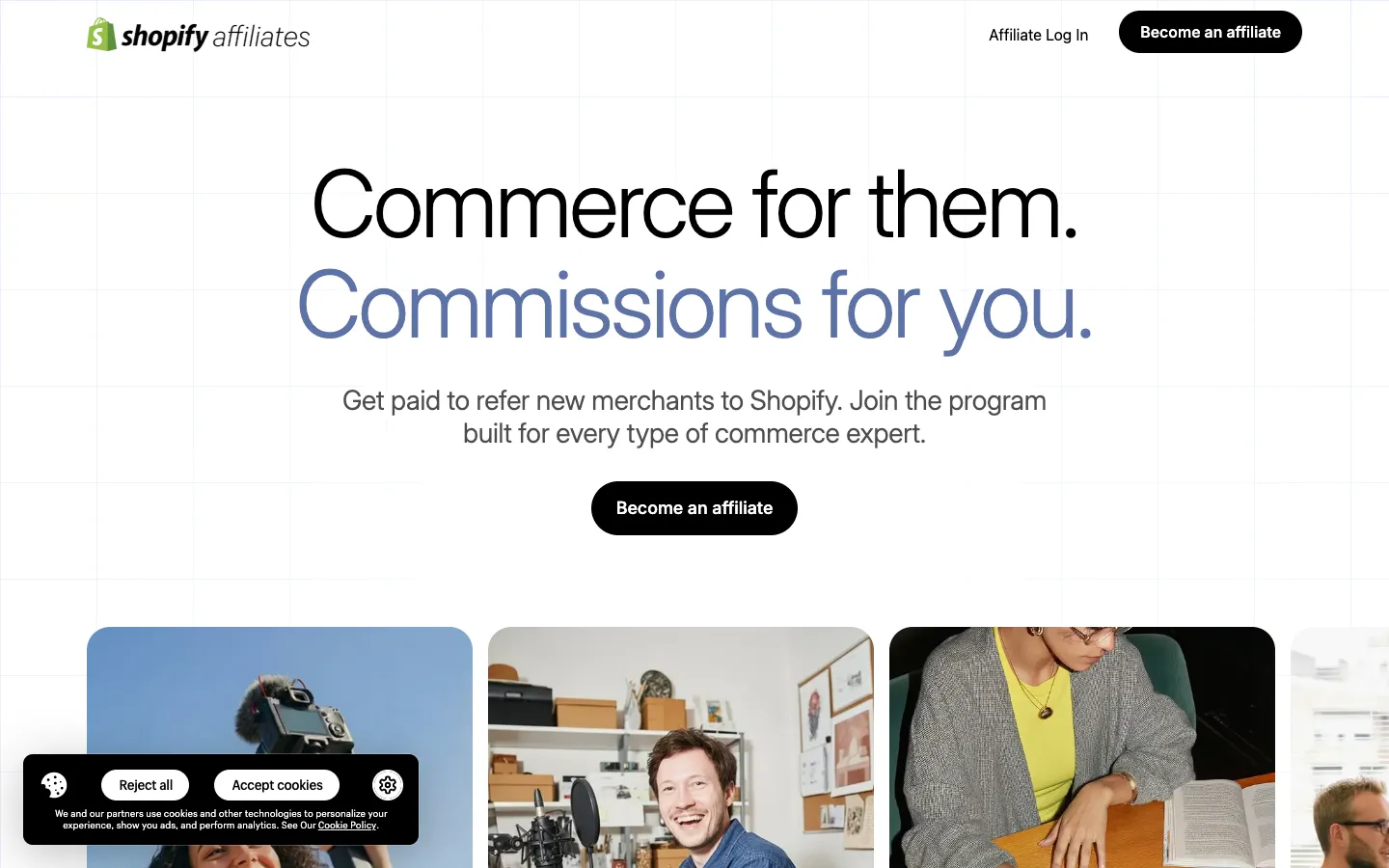
Shopify's affiliate program page is the gold standard for SaaS affiliate landing pages. It does almost everything right.
What they include
Commission: Up to $150 per qualified referral. No earnings cap.
Cookie duration: 30 days from link click, with extended tracking up to 400 days for free trial conversions.
Earnings calculator: An interactive tool where you input your expected monthly referrals and see projected annual earnings. Five referrals per month shows $9,000 per year.
Five affiliate persona cards: Creators, Course Makers, Content Publishers, Commerce Experts, and App Partners. Each card helps visitors self-identify as the right fit.
Ready-to-use marketing assets: Banners, videos, and ad templates available after joining.
Payout details: Monthly payments on the 22nd, $10 minimum threshold, 80+ currencies via direct deposit.
Why it works
The earnings calculator is the standout element. Most affiliate pages list a commission rate and hope visitors do the math themselves. Shopify does the math for you. Five referrals per month turns into $9,000 per year. That is not an abstract percentage anymore. That is a real number you can plan around.
The persona cards are equally smart. Instead of saying "anyone can be an affiliate," they show five specific types of people who succeed in the program. A course creator sees herself in the "Course Makers" card. A blogger sees himself in "Content Publishers." Self-identification drives signups because people think "this program was built for someone like me."
What they could improve
Shopify pays a flat $150 per referral with no recurring commission. For affiliates who send long-term Shopify customers, this means they earn the same whether the customer stays for one month or ten years. A recurring commission model would attract higher-quality affiliates who focus on sending customers that stick.
2. GetResponse: the affiliate page with tiered commissions
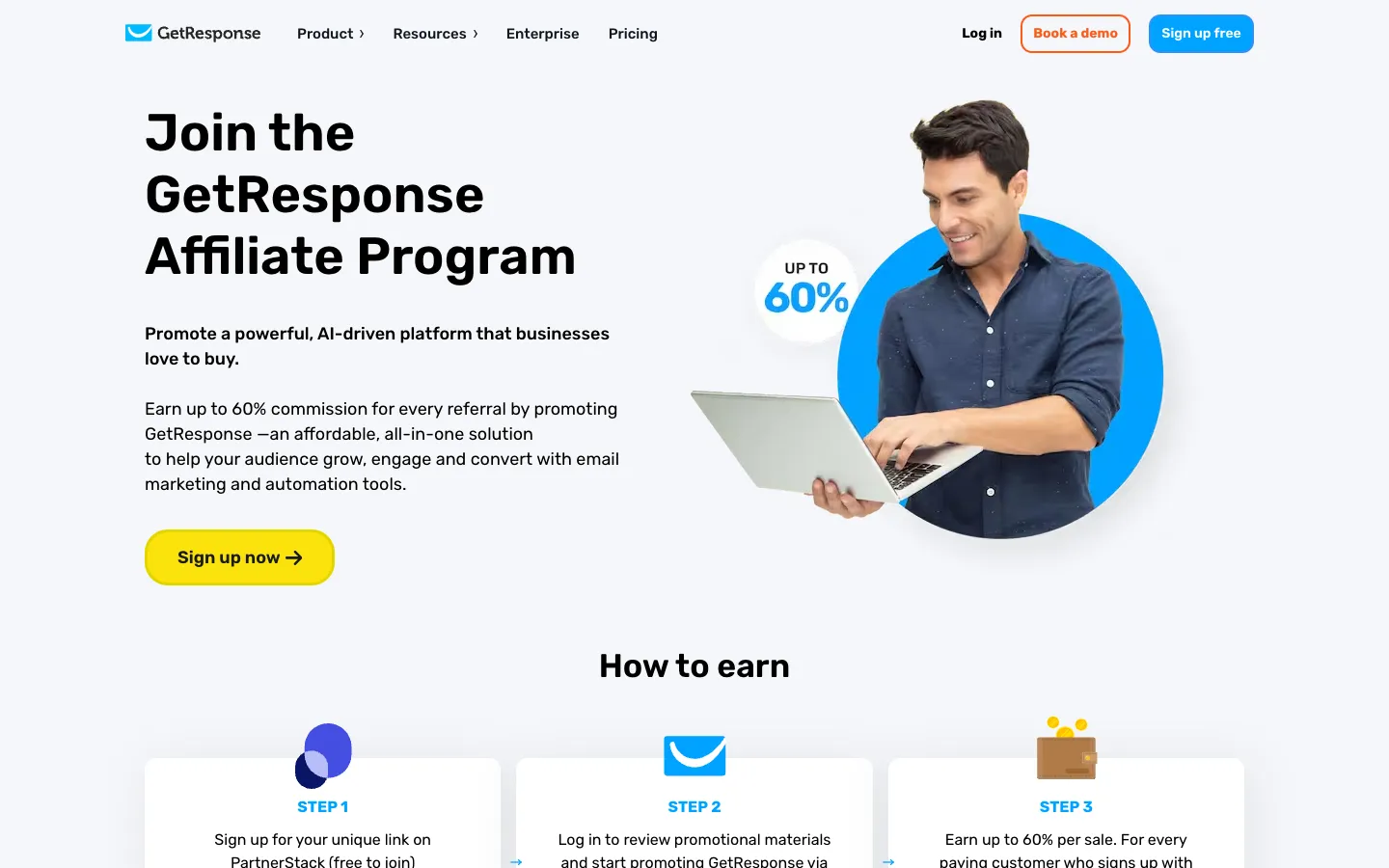
GetResponse has one of the most generous commission structures in SaaS, and their affiliate program page makes sure you know it immediately.
What they include
Commission tiers: Bronze: 40% recurring for 12 months. Silver (50+ sales): 50% recurring. Gold (100+ sales): 60% recurring. No income cap.
Cookie duration: 90 days.
Real testimonial with earnings: Leslie Samuel, a well-known affiliate marketer, shares that he earned over $90,000 promoting GetResponse.
Gold tier perks: Quarterly one-on-one meetings, Slack channel access, conference tickets, co-marketing opportunities, and personalized landing pages.
Trust signals: 25+ years in market, G2 and Capterra award badges, 183 countries served.
Why it works
The $90,000 testimonial is the most powerful element on the page. It transforms the program from "another affiliate opportunity" into "a proven income source." Very few SaaS companies publish real affiliate earnings data. GetResponse does, and it makes their page dramatically more convincing than competitors who hide behind generic claims.
The tiered commission structure also works brilliantly. Starting at 40% is already generous, but showing affiliates they can climb to 60% creates a goal. It turns the program into a progression system where effort is visibly rewarded.
What they could improve
The 12-month commission cap is a weakness. Affiliates earn recurring commissions for one year per referral, then the revenue stops. Compare this to programs that offer lifetime recurring commissions. For affiliates doing the math, lifetime recurring is always more attractive.
3. Kit (ConvertKit): the affiliate page with earnings examples
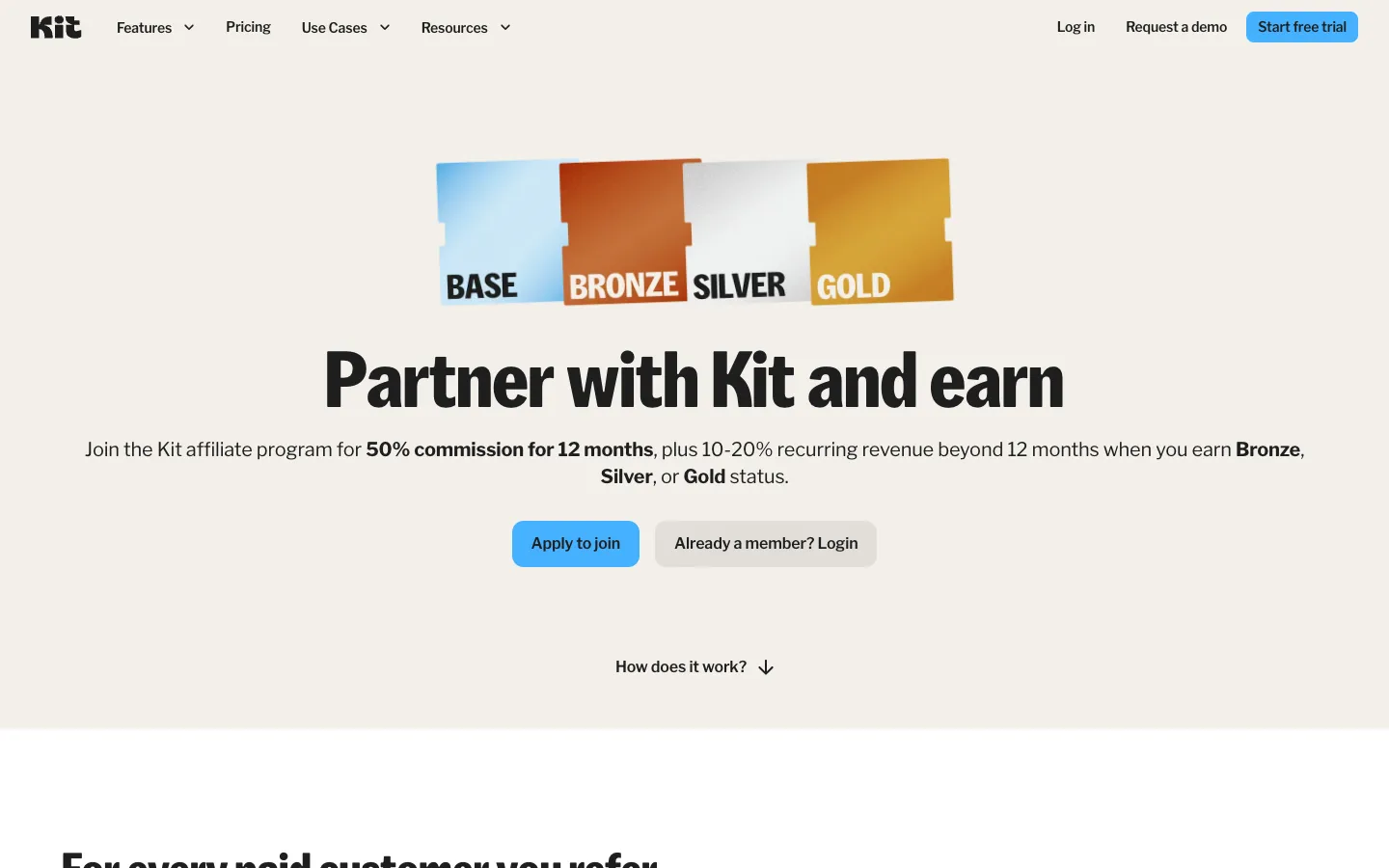
Kit takes a different approach than most. Instead of leading with commission percentages, they lead with a concrete earnings scenario.
What they include
Commission: 50% of referred customer payments for the first 12 months. Then recurring tiers: Bronze (10+ customers): 10% ongoing. Silver (50+): 15%. Gold (100+): 20% indefinitely.
Earnings example: A character named "Mac" refers a customer paying $1,200 per year. Mac earns $600 in the first year, then $120 to $240 per year ongoing depending on tier.
Tier badges: Visual tier system (Bronze, Silver, Gold) with clear thresholds for each level.
Affiliate Promotion Hub: A shared Notion workspace with promo materials, templates, and resources.
Why it works
The "Mac" earnings example is simple and effective. Instead of asking affiliates to calculate "50% of a variable subscription price," Kit shows exactly what Mac earns from one referral across multiple years. This storytelling approach makes the page feel personal rather than corporate.
The 50% first-year rate is also one of the highest in SaaS. It immediately grabs attention and positions Kit as a program that genuinely shares revenue rather than offering token commissions.
What they could improve
No cookie duration is listed anywhere on the page. For affiliates evaluating multiple programs, this is a red flag. Cookie duration directly affects how many conversions get attributed to the affiliate. Leaving it out feels like hiding something, even if the actual duration is competitive.
4. Teachable: the affiliate page with average earnings data
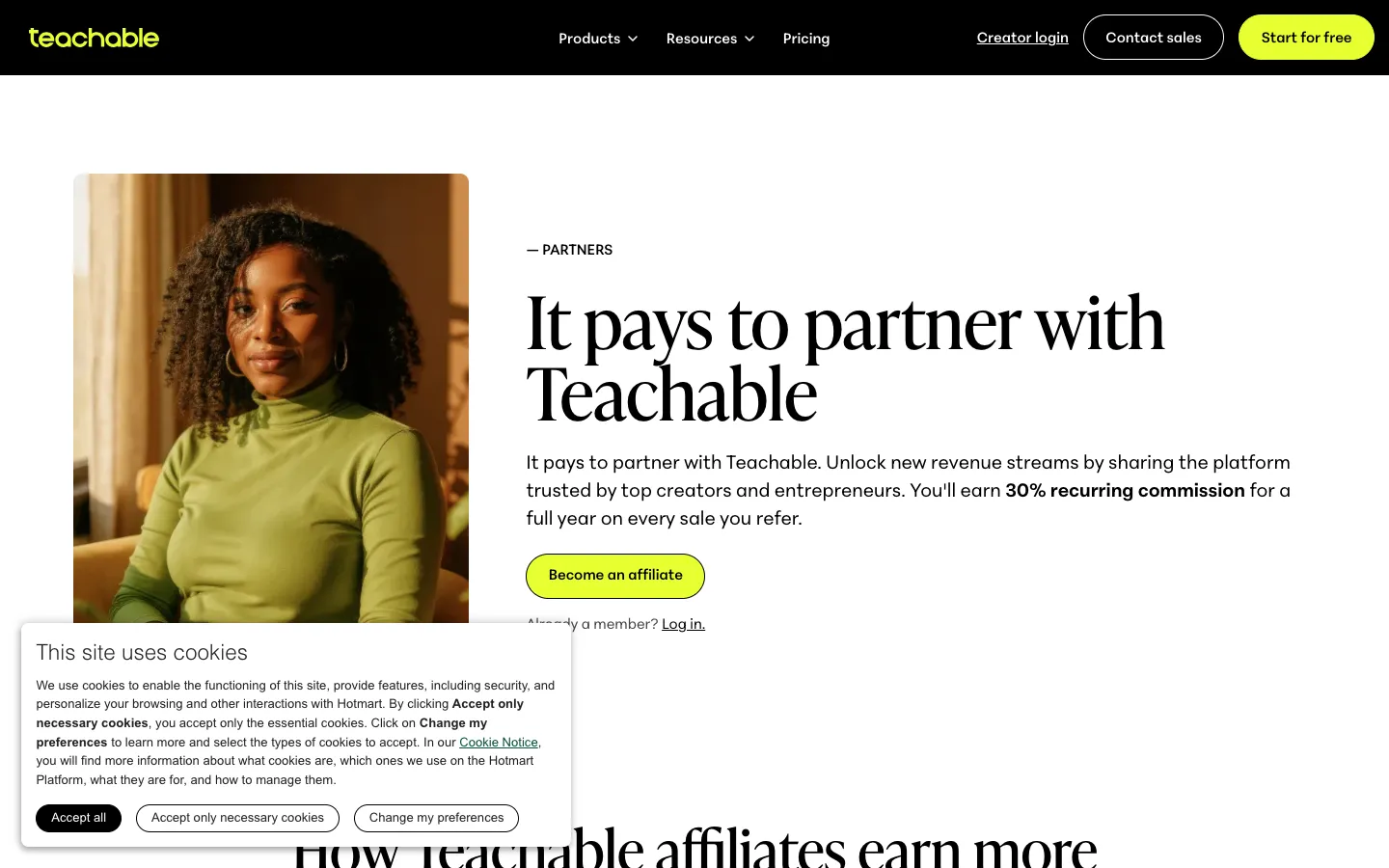
Teachable keeps their affiliate program page simple, but includes one detail that most programs avoid: actual average earnings.
What they include
Commission: 30% recurring for one full year per referral.
Cookie duration: 30 days.
Average earnings disclosure: "Partners earn $450 per month on average, many earn $1,000+ monthly."
Real testimonial: Abagail Pumphrey from Boss Project: "Getting paid to share something I use daily is smart business."
Application review: 2 to 3 business days.
Why it works
Publishing average affiliate earnings ($450 per month) is a power move. Most programs avoid this because either their numbers are embarrassingly low or they fear setting expectations. Teachable publishes theirs because the number is genuinely good. $450 per month from passive recommendations is meaningful income for content creators and course builders.
The testimonial also works because it comes from someone who uses the product. "Getting paid to share something I use daily" is the ideal affiliate mindset. It signals that Teachable affiliates are genuine users, not just commission hunters.
What they could improve
The page is thin. Only a handful of sections with no calculator, no resource previews, and no FAQ. Adding a visible FAQ section and some promotional material previews would increase the ability of the page to answer objections and reduce friction before signup.
5. ActiveCampaign: the affiliate page with per-referral earnings
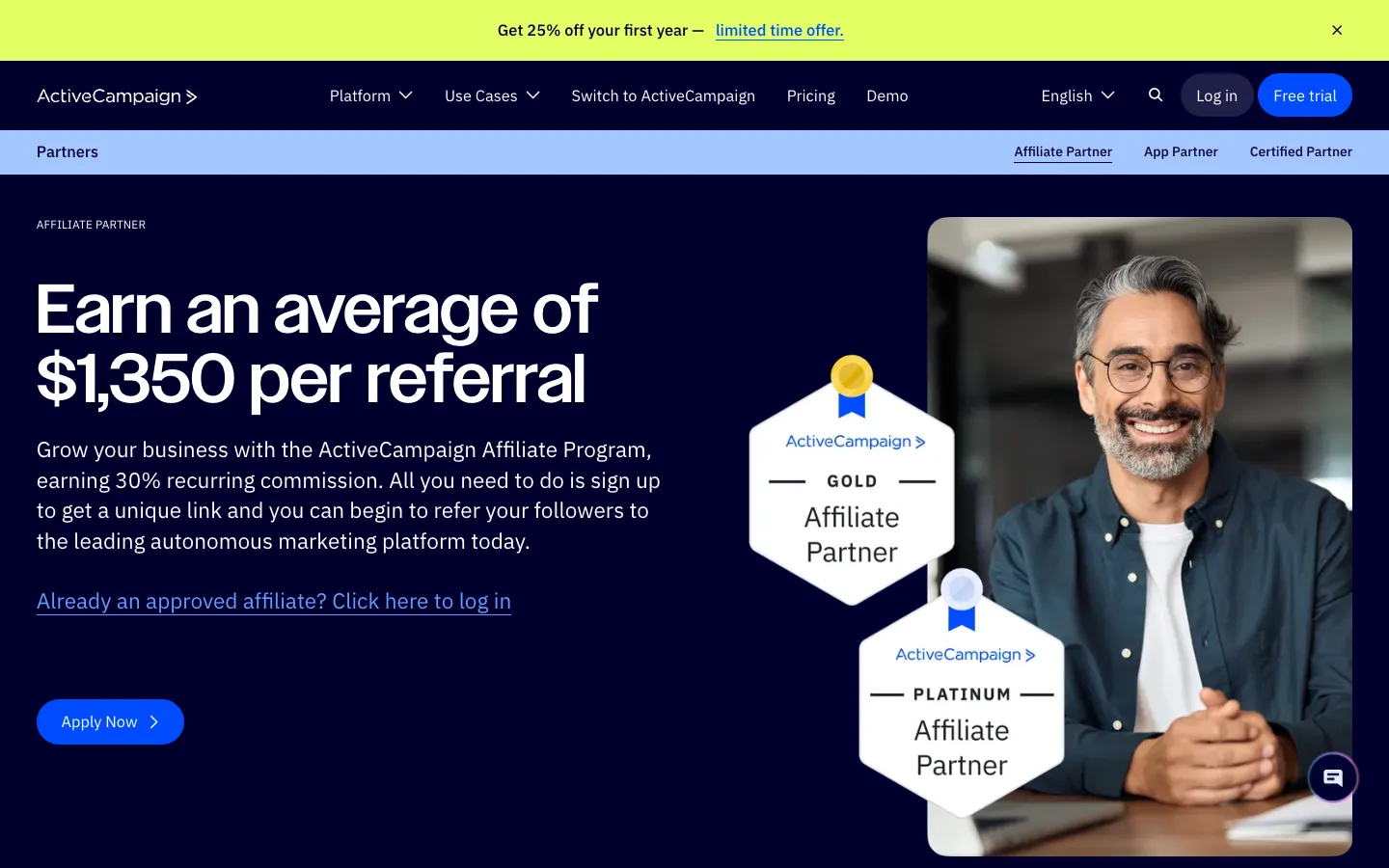
ActiveCampaign leads with a bold headline stat that immediately communicates value.
What they include
Headline stat: "$1,350 average per referral" is the first thing you see.
Commission: 20 to 30% recurring for up to 12 months. Starts at 20%, climbs to 30% based on volume and retention.
Cookie duration: 90 days.
Social proof: 4.5 out of 5 rating on G2 with 14,000+ reviews. 180,000+ customers across 170 countries.
Affiliate starter pack: Graphics, templates, and copy blocks provided after joining.
Why it works
The $1,350 per referral headline is brilliant because it reframes the commission from a percentage to a dollar amount. Affiliates do not think in percentages. They think in dollars. "$1,350 per referral" is immediately compelling in a way that "20 to 30% recurring" is not.
The G2 rating and review count serve double duty. They prove the product is worth recommending (affiliates do not want to promote bad products) and they give affiliates a talking point: "This tool has 14,000+ reviews on G2."
What they could improve
The scaling commission ("climbs based on metrics") is vague. Affiliates want to know exactly what they need to do to reach 30%. Clear thresholds like Kit's tier system or GetResponse's tier system would be more motivating than an ambiguous promise.
6. Notion: the affiliate page with hybrid commissions
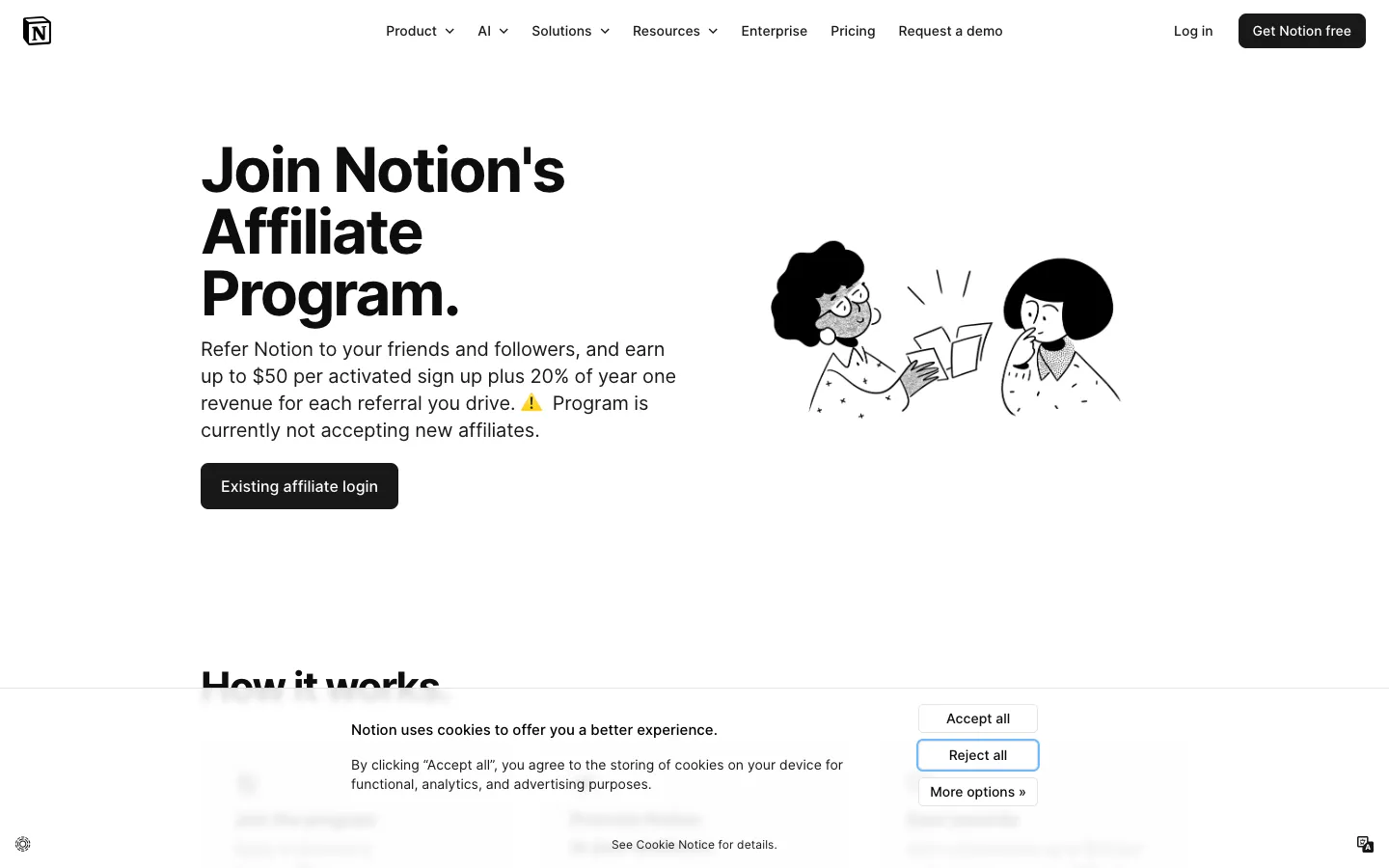
Notion's affiliate program page uses a hybrid commission model that combines a flat bounty with a revenue share.
What they include
Commission: Up to $50 per activated signup plus 20% of first-year revenue. Last-click attribution.
Conversion window: 180 days for new workspaces upgrading to paid Plus or Business plans.
Creator testimonial: Thomas Frank, a well-known Notion creator with millions of followers.
Eligibility categories: Bloggers, educators, newsletter publishers, template creators, AI content creators, ambassadors.
Affiliate Resource Center: Downloadable materials and brand assets.
Why it works
The hybrid commission model ($50 flat plus 20% of revenue) is smart because it addresses both short-term and long-term affiliate motivations. The flat bounty gives immediate gratification. The 20% revenue share rewards affiliates who bring in customers that upgrade to higher plans.
The 180-day conversion window is also unusually generous. Most programs offer 30 to 90 days. Six months means affiliates get credit for referrals that take time to convert, which is common in B2B SaaS where purchase decisions involve teams and trials.
What they could improve
The program is currently closed to new applicants. Having a live signup page that does not accept applications creates a frustrating experience. If a program is full, the page should either be taken down or offer a waitlist with email capture.
7. ClickUp: the affiliate page with compliance details
ClickUp takes a transparency-first approach. Their affiliate program page reads more like a partnership agreement than a marketing page, and that is actually a strength for serious affiliates.
What they include
Commission: Up to $25 per new free workspace referral. Tiered progression: Starter, Advanced (100+ signups per month), Premier (200+ signups per month).
Cookie duration: 30 days.
Detailed prohibited activities list: No adult sites, no brand bidding, no cookie stuffing, no self-referrals.
Qualification rules: Explicit exclusions for existing ClickUp users and customers who came through paid marketing touchpoints.
Payout schedule: Actions lock one month after tracking month ends. Approved transactions pay 15 days after lock.
Why it works
For experienced affiliates, the detailed compliance section is actually a selling point. It signals that ClickUp runs a professional program that protects both parties. Affiliates who have been burned by programs that retroactively disqualify commissions appreciate knowing the rules upfront.
The clear payout timeline is also valuable. Many programs hide their payment schedules in terms of service documents. ClickUp puts the exact timeline on the main landing page.
What they could improve
The $25 per free signup commission is low for SaaS, and there is no recurring component. Combined with the text-heavy layout and no testimonials, calculator, or video, the page reads like a legal document rather than an opportunity. Adding an earnings projection and at least one affiliate success story would significantly improve conversion.
Affiliate program page comparison: all seven at a glance
| Company | Commission | Cookie | Earnings proof | Calculator | Recurring |
|---|---|---|---|---|---|
| Shopify | $150 per referral | 30 days (400-day trial tracking) | No | Yes | No |
| GetResponse | 40-60% for 12 months | 90 days | $90K testimonial | No | Yes (12 months) |
| Kit | 50% year 1, 10-20% ongoing | Not disclosed | Mac example | No | Yes (lifetime) |
| Teachable | 30% for 12 months | 30 days | $450/mo average | No | Yes (12 months) |
| ActiveCampaign | 20-30% for 12 months | 90 days | $1,350/referral avg | No | Yes (12 months) |
| Notion | $50 + 20% year 1 | 180-day window | Thomas Frank testimonial | No | Partial |
| ClickUp | $25 per free signup | 30 days | None | No | No |
The pattern is clear: every high-converting affiliate page includes some form of earnings proof, whether that is a calculator, a real testimonial with numbers, or published average earnings. The programs without earnings proof (ClickUp) feel noticeably weaker.
How to build your own affiliate program page
Based on these seven teardowns, here is a checklist for building a signup page that converts:
The must-have elements
Commission rate above the fold. Put it in the hero section. Do not make affiliates scroll to find the most important number on the page.
Cookie duration and attribution model. 30 days minimum. Disclose it clearly. Hiding it makes affiliates assume the worst.
At least one concrete earnings example. Either a calculator (like Shopify), average earnings data (like Teachable), or a testimonial with dollar amounts (like GetResponse).
How it works in three steps. Apply, share your link, earn commissions. Keep it visual and simple.
A single prominent CTA. "Join the program" or "Apply now." One button, one action.
Mobile-responsive design. Many affiliates will discover your page on their phone. If the signup form breaks on mobile, you lose them.
The elements that set top pages apart
Earnings calculator. Shopify is the only program in this analysis with one. A calculator makes the opportunity tangible in a way that percentages alone cannot.
Tiered progression. GetResponse and Kit both show clear tiers that reward growing affiliates. This turns the program into a career path, not a one-time transaction.
Real testimonials with names and numbers. GetResponse's $90,000 testimonial and Teachable's $450 per month average are the most compelling elements across all seven pages.
Self-identification. Shopify's five persona cards help visitors see themselves in the program. If you serve multiple affiliate types (bloggers, consultants, agencies), show each one specifically.
FAQ section. Address objections before they become reasons to leave. Common questions: payment schedule, minimum thresholds, international availability, promotional restrictions.
Build your affiliate program page with Komissio
If you are setting up an affiliate landing page for your SaaS, Komissio includes a branded affiliate signup page builder as part of the platform. You can create a custom page at komissio.io/join/your-company with your own logo, colors, commission details, and custom application fields.
The page builder lets you:
Customize branding: Upload your logo, set a background color, and write your own headline and description.
Set commission details: Display your commission summary directly on the page so affiliates know what they earn before signing up.
Add custom fields: Collect additional information from applicants (website URL, audience size, promotion methods) with up to 10 custom form fields.
Auto-enroll or review: Choose whether new affiliates are automatically enrolled and given a referral link, or whether submissions go to your review queue first.
Track signups: See all applications and enrollments in your merchant dashboard with source attribution.
Setup takes about five minutes. You pick a slug, upload your logo, write your commission summary, and your affiliate page is live. See an example at komissio.io/join/komissio (yes, we use our own product for our own affiliate program).
Combine this with first-party tracking that works in Safari and through ad blockers, automated Stripe payouts, and a $49 per month flat fee with no revenue caps. Not sure if you are ready? Use our readiness checklist to find out.
Key takeaways
Key Takeaways
Every high-converting affiliate program page includes concrete earnings proof: a calculator, average earnings data, or testimonials with real dollar amounts.
Commission structure must be above the fold. Affiliates decide whether to keep reading based on this single detail.
Cookie duration and attribution rules should be disclosed clearly. Hiding them makes affiliates assume the worst.
Tiered commission structures (like GetResponse's 40-60% tiers) turn affiliate programs into progression systems that reward growth.
Self-identification elements (like Shopify's persona cards) help visitors see themselves in the program, which drives signups.
A branded affiliate program page with your own logo, colors, and custom fields signals professionalism and attracts higher-quality affiliates.
Frequently asked questions about affiliate program pages
What should I put on my affiliate program page?
At minimum: commission rate, cookie duration, how it works in three steps, a signup CTA, and one form of earnings proof (calculator, average earnings, or a testimonial with numbers). The best pages also include an FAQ, promotional material previews, and clear payout schedule details.
How long should an affiliate program page be?
Long enough to answer every question an affiliate might have before signing up. The best pages in this analysis (Shopify, GetResponse) are comprehensive but well-organized with clear sections. A thin page like Teachable's works if you have strong social proof, but more detail generally converts better.
Should I show commission rates publicly on my affiliate program page?
Yes. Affiliates will not apply to a program that hides its commission rates. Transparency builds trust and filters for affiliates who are genuinely interested in your offer. Every successful program in this analysis shows commission rates on the public page.
Do I need a custom-designed affiliate program page or can I use a template?
A platform-provided template with your branding (logo, colors, custom copy) works well for most SaaS companies. Shopify and GetResponse have custom-designed pages because they manage thousands of affiliates. For programs under 100 affiliates, a clean branded page built with a tool like Komissio is more practical and just as effective.
How do I drive traffic to my affiliate program page?
Link to it from your website footer, pricing page, and about page. Mention it in customer emails and onboarding sequences. Add a "Partner with us" link to your main navigation. Reach out directly to bloggers and content creators in your niche. The best affiliates are often found through direct outreach, not organic page traffic.